Friday, April 15, 2016

1000 Days of Protest

Easter marks the beginning of Northern Ireland’s “marching season,” a time lasting until August which is generally regarded as the tensest time of the year. The season peaks on 12 July, when the conservative Protestant Orange societies lead huge celebrations of the victory at the Battle of the Boyne, where Protestant King William III defeated Catholic King James II and reasserted Protestant control of Ireland.

The Loyal People's Protest Joins the March

Members of the Loyal People's Protest Previously Seen on St. Patrick's Day

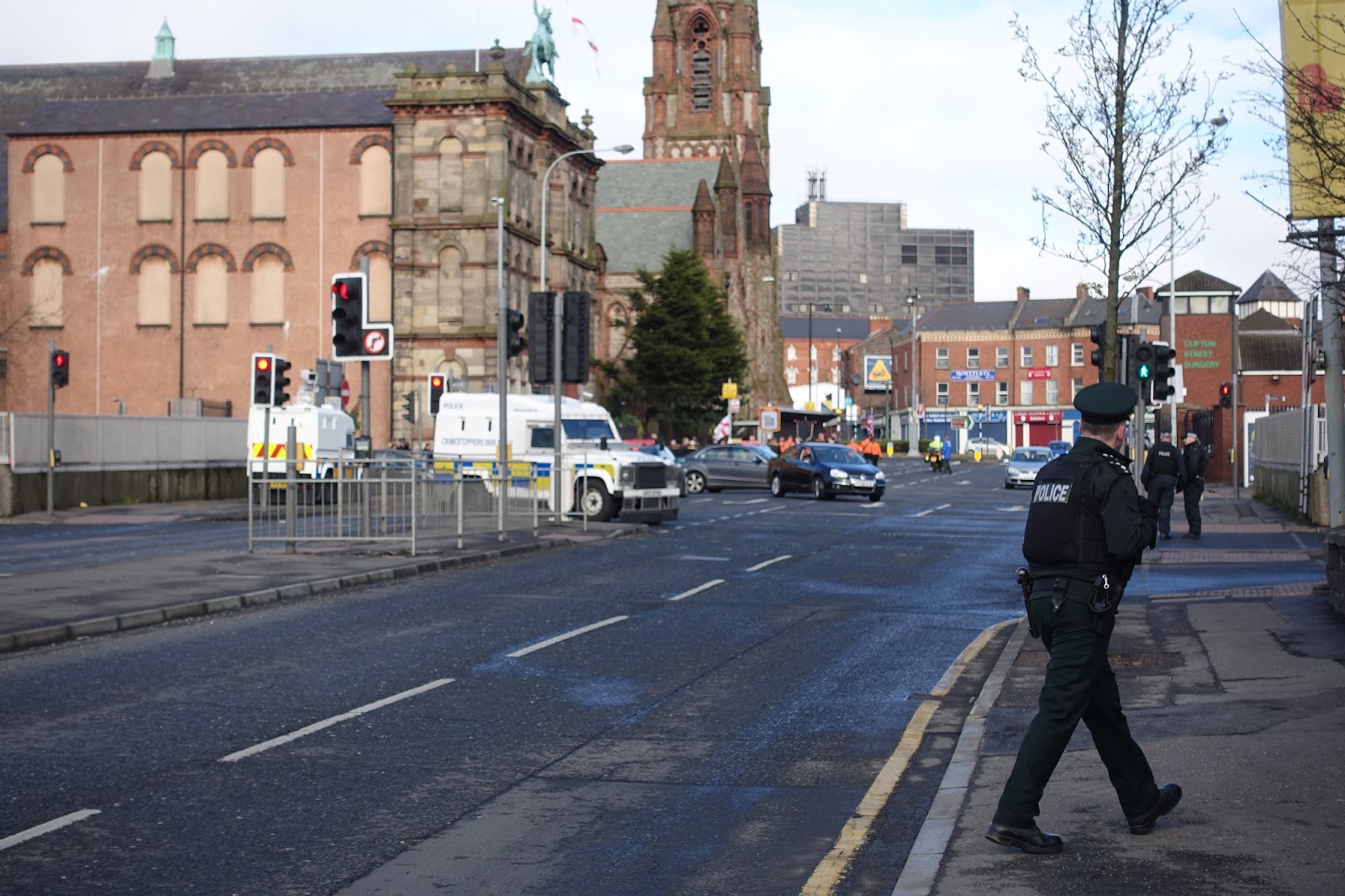
Even though it’s not July yet the Protestants have already begun to march, and gathering behind the ornate Orange Hall on Clifton Street, protest bands began to form up, preparing to mark the 1000th day of their opposition to the parades commission’s decision to block an Orange march in 2013 (the Orangemen I saw last Saturday were protesting this same decision). There must have been at least 1,000 people preparing to march or follow the parade down to Twadell Avenue, where the police wait in order to ensure that the march doesn’t pass by the Catholic area of Ardoyne. Ranging from highly professional groups in bright and ornate uniforms, to groups of teens in tracksuits and jeans, Protestants from all walks of life came together join in what was described by fliers pasted around the Protestant Shankill Road as an attempt to “highlight the injustice and discrimination against the protestant Community and to support the local orange parading tradition.”


Flier Advertising the March

Some Marchers in Diverse Outfits

 The bands were spread out during the march, in what an ex-army colonel described to me as an attempt to make the parade seem as long as possible. A fair amount of people gathered on the Shankill Road to watch the bands go past, although this march failed to gain nearly as many supporters as the Falls Road Easter Rising parade. One of the more interesting aspects was that many young children were present, either leading bands with red, white, and blue sticks or marching alongside the bands with their own little toy drum sets.


Marchers 

 As we approached the Twadell Avenue the presence of the P.S.N.I became much more overt. The police have a daily presence on the Twadell Avenue, where a group of diehard Unionists have set up a ‘base’ (Camp Twadell), which has had a permanent garrison for almost three years now. Flying dozens of Union Flags and with Unionist Banners hanging on the walls surrounding the camp they are an irritation to the Catholics in the nearby Ardoyne, an area well known for its continued support for dissident Republicans (the P.S.N.I believe that the recent prison officer bombing was planned in the Ardoyne). The police usually have at least ten Land Rovers stationed at Camp Twadell in order to prevent any violence that might arise at this North Belfast hot spot.


Banner at Camp Twadell

P.S.N.I on Twadell Avenue


Flags at Camp Twadell

Today there were even more flags than usual, and groups of protesters carried huge banners which commemorated three Scottish soldiers “murdered by your neighbours” in 1971, and stating that “Protestants have human rights too.” Behind these protesters was a makeshift podium, draped in Union Flags and behind that the classic line of armoured Land Rovers which have become a staple of Northern Irish protests.


Protesters at Camp Twadell

Protesters at Camp Twadell

Protesters at Camp Twadell

Protesters at Camp Twadell

 By now it was getting dark and because I didn’t know the area very well, I thought it best to leave. Getting lost in the working class estates of Belfast after nightfall is not something that appeals to me. 

Below I’ve attached a short video which shows some of the march:


Best Wishes,
 Luke van Reede van Oudtshoorn

Sunday, April 10, 2016

The Easter Rising


On the 24th of April 1916, Easter Monday, Dublin was thrown into disorder and chaos as around 1,200 armed Republicans seized strategic buildings around the city. From the steps of the General Post Office, Patrick Pearse, one of the leaders of the uprising, read a proclamation that declared Ireland an independent republic. The revolutionaries initially hoped that Irish Republicans all across the island would take up arms in conjunction with the unrest in Dublin, but confusion and poor organization meant that the Easter Rising was an affair that took place almost entirely within Dublin. The British government reacted quickly to this unrest, and after a week of brutal street fighting which saw hundreds of innocent people killed in the crossfire, British rule was restored to Dublin. The leaders of the rebels were marched through the streets as crowds booed and jeered. Tried for treason, the leaders were shot. However, while the British might have killed these revolutionaries, their deaths gave new life to the idea of Irish Republicanism, and by 1919 Ireland would have its independence. The events of this short week in 1916 continue to influence events even now, one hundred years on. In Northern Ireland the Easter holiday lasts from Good Friday until Easter Tuesday, over this long weekend there are celebrations throughout the Republic of Ireland and the Catholic areas of Northern Ireland. The celebrations for the hundredth anniversary of the rising were expected to be especially large. The P.S.N.I also warned of possible dissident Republican attacks during the lead up to this year’s commemorations, although none materialized.


Good Friday

Good Friday was relatively quiet, at least in Belfast, but in the town of Newry some hooded youths decided to try to relive the revolution by stoning some passing P.S.N.I vehicles.

Saturday
In 2013 a group of Orangemen were stopped by the police from marching home along their traditional route because they would have to pass by a Catholic neighbourhood. This seemingly small act caused huge outcry among the Loyalist community, and the Orangemen decided that they’d not just give up and let the parade’s commission tell them when and where they could march. Since then they have marched every night and every Saturday afternoon to protest what they view as the attempt by the parade’s commission to infringe on their freedom of assembly at the behest of “intolerant nationalists.” So they march, day after day, and day after day they are greeted by a wall of armoured cars and police officers who force them to follow the parade’s commissions’ instructions and prevent them from reaching the Catholic area. On Saturday I followed these Orangemen during their parade, starting at the Shankill Road Orange Lodge and ending at the usual police barricade. The march was surprisingly low key, the Orangemen marched silently through a Protestant neighbourhood that seemed largely uninterested in what they were doing.


Orangemen March on the Shankill


Orangemen March on the Shankill

As we approached the Parade’s Commissions’ ‘line in the sand’, the P.S.N.I Land Rover that had been acting as point man for the march peeled off down a side street to our right, blocking all movement down that way. The Orangemen kept pushing forward towards the Crumlin Road, their ultimate goal, all that seemed to lay in front of them now was a small hill. Our little company began their ascension, but as we neared the summit the white roofs of the P.S.N.I Land Rovers waiting for us at the top came into view. There were four or five armoured jeeps parked on either side of the street, with a wall of green coated officers standing between them. 


Orangemen Face the "Thin Green Line"

The Orangemen stopped right in front of that thin green line, once again the parade’s commission would have its way, but these marchers weren’t finished yet. One of them pulled out a camcorder and tripod, formed their own line in front of the police. 


Orange Line

One of the Orangemen brought out a microphone, “I’ll be celebrating the Easter Rising, the true Easter Rising, Jesus Christ is risen today alleluia … that is the true Easter Rising” he said. After the sermon a new speaker came out from the crowd, and had a markedly more political view of events. “We do not gather … to cause offence, we gather to highlight the intolerance and injustice that we face.” Claiming that the parade’s commission wants to criminalize them “simply for walking” he stated defiantly that the “protests will continue.” As the colours were trooped away, the Orangeman began to remove their hats, and sang the first verse of God Save the Queen. I’ve attached the entire speech below in case you’re interested in watching it yourself.


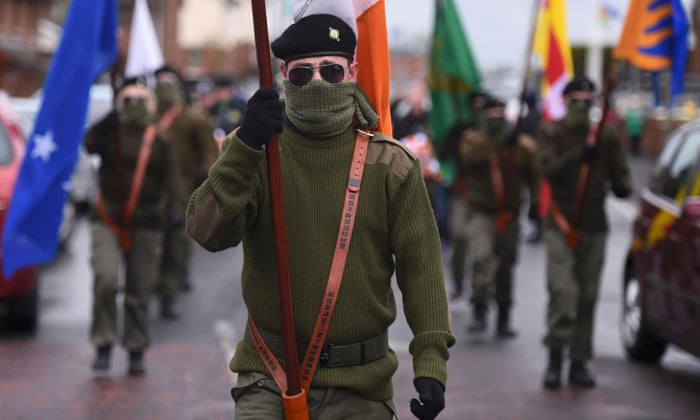
Elsewhere in Ulster, unrest that would flare up again and again over the course of the weekend began in the county Armagh town of Lurgan. During The Troubles, Lurgan was part of “murder triangle” an area infamous for its high number of sectarian attacks and killings. Today Lurgan is one of the few areas in Northern Ireland where dissident Republicans hold a significant amount of support, and that support shone bright this weekend. On Saturday a dissident Republican colour party marched through the Kilwilkie Estate dressed in paramilitary uniforms and hiding their faces with masks. While they were observed by a police helicopter, the P.S.N.I did not make any attempt to stop the parade, even though it was in violation of Northern Irish law which maintains that all marches must be approved by the Parades Commission before they can go ahead. 


Dissident Marchers in Lurgan (Photo Credits: Clodagh Kilcoyne)

This brazen show of strength by the dissidents, coupled with the P.S.N.I’s failure to respond outraged Unionists. News Letter reported that the Traditional Unionist Voice’s candidate for Upper Bann stated in response to the march: “If this had been a Loyal Order parade the P.S.N.I would have been present in numbers to ensure the letter of the law was observed. Yet republicans have been permitted to put on a show of strength with masked men with no arrests.” Lurgan’s woes didn’t end as day turned into night on Saturday, and in fact they’d only grow worse over the course of the Easter Celebrations.

Easter Sunday
The Easter Sunday parade on the Falls Road was probably the largest parade I’ve ever seen, and while it might not have attracted as many spectators as the Macy’s Thanksgivings day Parade, the turnout was still unbelievable. Ten of thousands stood under the tricolours and green, white, and orange bunting that weaved between the lampposts like a spider’s web. Alongside the tricolours flew the green flag of “D-Company,” West Belfast’s local I.R.A. unit during The Troubles. Before the official parade began, the veterans of “D-Company” marched down from Barrack Street to the local I.R.A Garden of Remembrance on the Lower Falls (There’s a photo of this garden on my earlier Falls Road post.) Dressed in paramilitary uniforms, their little troop was greeted enthusiastically by the audience during their short march. 

 "D-Company" Marches

"D-Company" at Attention

Once they reached the Garden, their spokesman addressed the assembled crowd by saying: "British rule was wrong in 1916 and it is still wrong in 2016. Let no-one tell you any different. We will settle for nothing less than a declaration of independence." “Amhrán na bhFiann,” the national anthem of the Republic of Ireland, and a decade of Rosary in Gaelic were then recited, to the cheers of the assembly. All throughout this, a P.S.N.I helicopter was keeping watch, and when someone in the crowd threw up a drone to get a better view of the parades, a group of men around me starting cheering that the drone was “their air force,” and that it was going to go shoot down the helicopter!


Speakers on I.R.A Memorial


I managed to get very lucky with where I stood in the crowd, somehow I managed to find myself in the same place that the Sinn Fein organizers had decided to put the families of the Republicans who had been killed during The Troubles. Each of them carried a little black and white photo of the son, daughter, wife, husband, or whomever else they lost, it was quite heartbreaking actually. Once “D-Company” had finished their rally, the official parade began. Led by a colour party of men and women dressed in the uniforms of the original Irish rebels of 1916, and carrying dummy rifles from the time, they marched up the Falls towards the Milltown Cemetery. As the colour party passed by the families of those who died they stopped, turned to face them, and saluted. The families then made their way into the parade, and formed a huge party of followers to the colour party. Once they had passed the flute bands came, at least twenty different Republican bands marched in behind the colours, although not all of them were Irish. I saw at least two from Scotland, two American pipe bands from New York, and I even saw someone carrying the flag of the Basque Nations! If you want to watch the parade, I've attached a link to what I filmed.


 Families of Republicans Who Were Killed


Huge Crowds on the Falls 


 Huge Crowds on the Falls


 Marchers in Period Clothes


Marchers in Period Clothing 
I decided to move with the parade up towards Milltown, and came face to face with the horror of Irish weather; it felt like the conditions went from freezing downpour to scorching sunlight every five minutes. Once the parade finished at Milltown, the crowd shuffled into the Cemetery towards a large stage that the organizers had assembled.
 Milltown Cemetary


Milltown Cemetary 
 Here Gerry Adams, the leader of Sinn Fein, gave a speech. It’s not the first time he has been at the Milltown Cemetery, he was there when in 1988 a Loyalist named Michael Stone attacked an I.R.A funeral with bombs and a handgun, killing three. Gerry Adams was heavily involved in the Republican movement in the 1970s and 80s, and many of the Protestants I talk to are adamant that he was one of the Provisional I.R.A’s top men during The Troubles. For being an accused I.R.A man his speech was surprisingly supportive of the Peace Process. “Huge progress has been made in recent years. The Peace Process and the Good Friday Agreement marked a historic shift in politics on this island. For the first time, the roots of conflict were addressed and a democratic route to Irish unity opened up. But there is much yet to be done” he stated, although he still towed the classic Republican line, accusing the government of the Republic of Ireland of betraying the revolution, and demanding the British “imperialist” government's withdrawal from the North. I’ve attached a link to the whole speech, filmed by Sinn Fein, below (I actually filmed it all myself but you can’t hear a thing because of the wind, so I had to find another recording.)
Back in Lurgan masked Republicans marched again, and the “Army Council” of the Irish Republican Army issued new threats against the security services, and warned that police officers may be targets. The council stated that “The volunteer soldiers of the I.R.A are ready and determined to take the war to the age-old enemy of our nation.” In addition, an ex I.R.A man, Bernard Fox, who survived the infamous 1981 hunger strike in the Maze Prison told the media that Republicans are entitled to use “any means necessary” to end partition. (Information Credit to the Irish News)
Easter Monday


Tensions in Lurgan reached a peak on Easter Monday, as a huge gathering of around 60 Loyalist bands from all over Ulster prepared to march through the city. I actually watched one of the bands pass by the Clifton Street interface area in North Belfast on their way to be bussed to Lurgan. The police response was unbelievable, with more armoured cars than marchers being present, and officers with rifles guarding each street corner. I've attached a link to what I filmed below.


 Protestants might ask why their parades are watched so diligently by the P.S.N.I, while Republican parades always seem to have a minimal police presence, although after the events in Lurgan that morning I can understand why they might have been on their guard.
 Heavy Police Presence at Orange March


Heavy Police Presence at Orange March
 At about 4:30 a.m. a van was hijacked and set alight on the railroad from Belfast to Dublin that passed through Lurgan’s Republican estates, forcing the closure of the trains for 24 hours. When police arrived at the scene three petrol bombs were thrown at them, fortunately no injuries were sustained. The rest of the morning was quiet, and the huge Loyalist gathering, under heavy police guard, passed without incident. However, several hours after the Loyalist parade passed unrest flared up again, with several masked youth’s threw stones and petrol bombs at police Land Rovers, injuring two P.S.N.I officers. Two fifteen year old boys were arrested in response. Youths in Londonderry also threw petrol bombs and stones at police Land Rovers, although there were no injuries or arrests as a result of this. (All information credit to the Irish News)
Passive Aggressive P.S.N.I sign at Londonderry Republican Parade (Photo Credits: Irish News)

Petrol bombs thrown at police at Derry Easter commemoration
Youths Throw Petrol Bombs at P.S.N.I in Londonderry (Photo Credits: Irish News)


Until Next Time!

-Luke van Reede van Oudtshoorn 

Sunday, April 3, 2016

Security in Northern Ireland

Hey guys!

It has been a very eventful past week, and I’m very excited to share all the details with you soon. However, the Easter Rising post will take some time to be released, as it will be richly detailed, so today I’m going to give you a short history on Northern Ireland’s security services, and how they’ve changed since The Troubles. 


I’ve heard the locals describe the Police Service of Northern Ireland (P.S.N.I) in a variety of ways: “a colonial occupation force”, “a specialized service”, “defenders of the Orange regime”. All that is certain is that the P.S.N.I aren’t your average bobbies on the beat.


P.S.N.I Land Rovers in a Republican Neighbourhood

Now I can’t speak for everyone, but from what I’ve personally seen, the P.S.N.I seem to be an extremely professional group of people. I’ve attended parades by both Republicans and Unionists, and the P.S.N.I has been present at both. To me it seems as if they are a very neutral force. During the St. Patrick’s Day unrest they were very efficient and were quick to act, preventing the unrest from developing into anything worse. I’ve heard accusations that the P.S.N.I are slow to respond to actual crimes (P.S.N.I officers have been lead into Republican ambushes by fake emergency calls before, so I can understand their caution), and that they won’t go into Catholic areas for fear of starting riots, but based on what I’ve seen they do seem to be trying to do their best to act as a neutral force that helps both communities.

P.S.N.I at St. Patrick's Day Unrest

The origins of the modern P.S.N.I are in the Royal Ulster Constabulary (R.U.C), the predecessor of Northern Ireland’s modern police service and a group that worked side by side with the British Army during the bloody fighting in Northern Ireland during the 20th Century. The Royal Ulster Constabulary began its life as a small, local police service, responsible only for Northern Ireland after Ireland was partitioned in 1921. Until 1970 the R.U.C never exceeded 3,500 members, however, as fighting intensified in the mid-1970s recruitment was ramped up, and by 2001 the R.U.C had around 8,500 officers. The R.U.C was always a mainly Protestant force, with only around 7-8% of members coming from the Catholic community. Because of this the R.U.C was always viewed with suspicion by the Catholics, and allegations of corruption were common. Even now many Catholics are convinced that the R.U.C worked with Protestant paramilitaries and even Robert, the Sinn Fein community worker I interviewed, told me that he was certain that the R.U.C colluded with the U.D.A and U.V.F.


Armed R.U.C Officer During The Troubles (Photo Credits to TheJournal.IE)

This is the legacy that the new P.S.N.I has inherited. Many people I’ve talked to have told me that there hasn’t been any substantial changes in the structure of the P.S.N.I when you compare it to the R.U.C. Robert even told me that the leadership of the P.S.N.I is made up of old members of the R.U.C's special branch, which he believes was responsible for state sponsored killings during The Troubles. While I can't speak for the truth of the accusation; it is true that the P.S.N.I was born out of the R.U.C in 2001, when the R.U.C was officially renamed the Police Service of Northern Ireland, and changed its emblem to something that better represented both Unionists and Republicans. A simple name change wasn’t enough, and the former R.U.C was reformed in two major acts passed by the British government, the Police (Northern Ireland) Act 2000, and the Police (Northern Ireland) Act 2003. The acts made some remarkable changes to the way policing is done in Northern Ireland, so much so that because of these acts Sinn Fein has officially come out and supported the P.S.N.I as a legitimate police force which was something difficult to imagine during the days of the R.U.C. You can read the acts by clicking the links above.


Central Belfast P.S.N.I Station

One of the most important, and controversial, policies implemented during this reformation period was the “50-50” recruitment policy. 50-50, a system of affirmative action which meant that an equal number of Protestants and Catholics had to be hired, was supposed to show the world that the P.S.N.I was committed to impartiality and professionalism. However, 50-50 proved to be unpopular among Northern Ireland’s Protestants, who feel like they were being discriminated against by the P.S.N.I’s recruitment office. While it has been successful in bringing more Catholics into the police, its unpopularity proved to be its downfall and in 2011 the policy was discontinued. Catholics now make up about 30% of the P.S.N.I, but only around 17% of new recruits are Catholic, leaving many to wonder if Republican Paramilitaries are still intimidating Catholics into staying away from law enforcement. Catholic officers do seem to be targeted by dissident Republicans, who see them as traitors, and several have been killed in terrorist attacks in recent years.


P.S.N.I Officers at Orange Parade in North Belfast


While they might still ride around in their armoured land rovers, and work in walled police stations that remind onlookers of places like Fort Knox or Windsor Castle, the P.S.N.I has definitely changed since their heyday during The Troubles. Northern Ireland is still a dangerous place for a policeman, and the police are certainly stuck between a rock and a hard place. There are vocal critics of them in both communities, and they have to deal with not only crime and terrorism, but also significant budget cuts which are most certainly hampering their efforts to make the streets of Northern Ireland safer for everyone. However, it will take time for them to reconcile themselves with the Catholic community, and probably even longer before they can become “normalized” police service, as opposed to the heavily armed outfit that they have been since The Troubles erupted in 1969. 

Until next time

-Luke van Reede van Oudtshoorn

Friday, March 25, 2016

St. Patrick's Day

St. Patrick's Day has become a celebration of all things Irish, and 17 March is greeted with jubilation around the world. There's been a huge amount of effort put into making all St. Patrick's Day celebrations non-sectarian, but still it is a day that is not really popular among Ulster's Protestants. However, this hasn't stopped the city from organizing a parade down Royal Avenue, Belfast's central street, every year. The parade went very well, everyone seemed to have fun, but it was the events after the parade that show that Belfast's sectarian divide still hasn't totally disappeared.

St. Patrick's Day Parade on Royal Avenue 

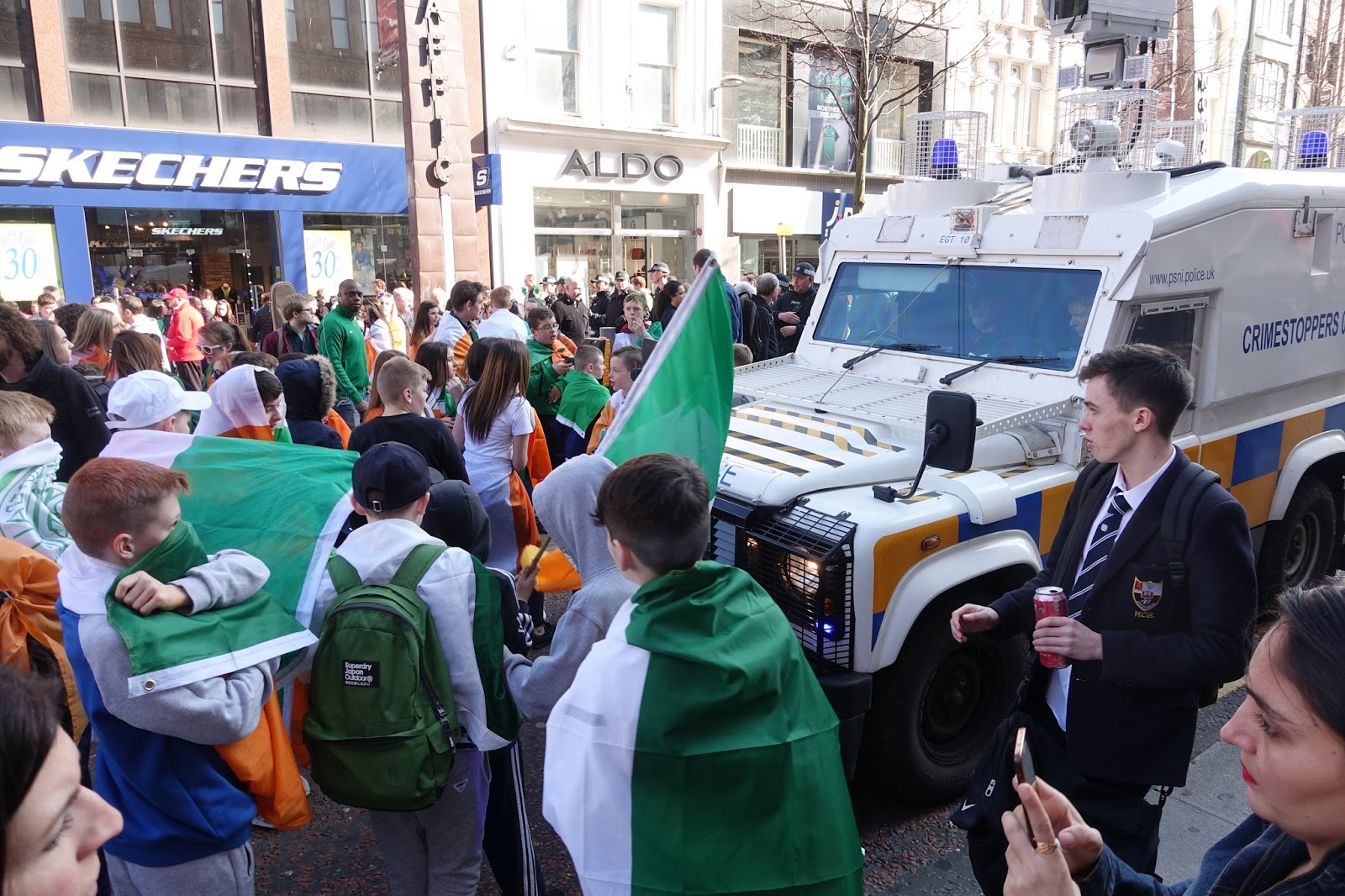
Right out in front of city hall a group of protesters-the Loyal People's Protest group-started to gather. While St. Patrick's Day might be a celebration of everything Irish, they wanted to remind all Ulstermen that Northern Ireland stands with the United Kingdom, and not the Republic of Ireland. Some P.S.N.I officers were on the scene, to make sure the protest didn't grow into something dangerous. Almost as soon as the Loyal People's Protest put up their first Union Flag, youths draped in Irish tricolours began to gather on the opposite side of the street.


 Unionist Demonstrators at City Hall


Republican Counter Demonstration

 Within minutes the small group of youths had transformed into a large crowd, and a fairly tense standoff began. More P.S.N.I officers arrived, forming a bright neon yellow line in front of the Republicans to make sure that the two groups didn't come into contact with each other. However several kids, probably no older than eleven or twelve, sneaked passed the police line and walked right in front of the Unionists-taunting them with Irish tricolours. The P.S.N.I quickly hurried that kids along.

As I mingled among the Republican congregation, I flagged down a young Republican who was willing to speak to me about the situation. In this recording you can hear the background noise of the protest, and I'm very happy to be able to provide a first hand statement by someone who was involved.


I tried to speak to the Unionists after I finished this interview, but they were not interested in talking to me. 


 Police Line in Front of Republican Demonstrators 


 Tricolours in Front of City Hall


Tricolours in Front of City Hall

Tensions were beginning to mount, every once in a while one of the groups would start shouting and cursing-until a police officer would come over and reprimand them-while the other side watched on. Some teenagers in the Republican crowd started to set off green smoke bombs, and the whole Republican line became engulfed in a wispy green cloud. The P.S.N.I just watched on, it seems that over the years they have learned that unless a crowd is getting violent it's best not to intervene.

 Smoke Bombs at City Hall


Second Smoke Bomb Goes Off


 The tension seemed to be dissipating, when suddenly a red flare streaked across the sky, right over the top of a P.S.N.I armoured jeep, and landed right in the centre of the Unionist protest group. The startled Unionsists began cursing and jeering at their Republican adversaries. The situation was taking a turn for the worse, and the P.S.N.I moved in to restore order. Officers grabbed the two boys who threw the flare, and dragged them into the back of a police van. The Republican line collapsed and began to retreat away from the city hall. As the Republicans sang rebel songs, and chanted "I.R.A", police land rovers started to arrive in front of city hall, and police officers in armour formed a line and began to walk the Republicans down Royal Avenue.

Republican Retreat to the Intersection

The Republicans moved back in an orderly manner, and while occasionally a group of teens would form a circle and chant pro-I.R.A slogans; the entire group, which now must have numbered in the hundreds, had moved back at least 200 metres from the Unionists. The Republicans occupied an intersection just North of the city centre, and all roads leading to it were quickly blocked off by armoured land rovers and P.S.N.I officers.

 Republicans Now Occupy the Intersection


Hundreds Have Gathered in the Intersection

The police line held, and the boys in blue stopped anyone draped in a tricolour from moving through the line towards the Unionists, but let anyone who wasn't in anything overtly sectarian move through freely. The situation was still tense: kids no more than ten years old were using green spray cans to write I.R.A on their tricolours, and at one point a bottle flew threw the air and slammed onto the bonnet of the lead police land rover.

 Police Block the Way to City Hall


 Behind the Police Line


 Youths Taunt the Police with Tricolours


 Youth with IRA Tricolour


Police Stop Sectarian Symbols from Moving Through


Line of Armoured Cars in Front of City Hall

However, in time the mood changed from a sectarian protest to just another Irish St. Patrick's Day party, and even though a lot of the boys had I.R.A written in green ink on their cheeks they now seemed more interested in impressing the girls than in standing up to British rule. People stopped singing sectarian songs, and everybody seemed to want to pose for photos.

 Youths Pose for Photographs


 Youths Pose for Photographs


 Youths Pose for Photographs


The Party Starts to Die Down

This went on for quite some time, around two to three hours, until the police land rovers started slowly inching their way backwards. During that time police officers had managed to infiltrate the crowd and clear up the roads, so they could drive their jeeps through the intersection every now and then. As they started to leave the cleaning crews showed up, and began to try to clean up the whole intersection. It was at this moment that I decided it was time to leave. As I passed through the police line and back towards city hall, I noticed that a group of Republican protesters had been allowed to have a counter demonstration back where the original Republican crowd had gathered.

Protesters Remain in Front of City Hall

For all the effort put into trying to remove the sectarian implications of the St. Patrick's Day celebrations, it's clear that it'll take years for this celebration to become something that everyone in both the Republican and the Unionist communities can cherish.

I actually managed to take about five minutes of video footage of the events, so if you'd like to see it click the link below. I must warn you though, there is foul language.


This weekend is going to see some major celebrations for the 100th anniversary of the 1916 Easter Rising, and I intend to keep you all up to date with the events of the celebrations.

Until next week!

-Luke van Reede van Oudtshoorn


Tuesday, March 22, 2016

Hearing from the Locals

Two days after I went up the Falls for the first time, on Monday, I went back, to try to get some local insight on the Republican movement. The atmosphere was totally different to how it had been on Saturday; the sunny, light blue skies had been replaced with a dark and foreboding grey, and there was the constant drizzle of rain. I was actually pretty nervous going up there, I didn't have a plan on who I was going to interview, but knew that I desperately needed to hear the Republican side of the story, and soon. Unlike before, the Falls was dead on Monday, I only saw two or three people on the street while heading up, and there certainly weren't any protesters out this time. I had to get some contacts, so I ducked into the old Victorian library to see if the librarian knew anybody who'd be willing to talk to me. Fortunately for me the head librarian was very friendly, and gave me a list of four names and phone numbers to check out. She also recommended that I go into the Sinn Fein office next door and see what they had to say. I walked into the receptionists office, and was greeted by a large jovial man who introduced himself as Robert.

Robert was all too happy to talk to me, and even beat me to it and asked me if I wanted to record our interview! Of course I said yes, and he led me to his office down the hall. We sat down in the small, cramped room; he gave me the impression of a very busy man, the noticeboard behind him was almost totally obscured by the multitude of papers pinned to it, and all over the floor were boxes of fliers for Republican events. At first he was interested in knowing why someone from across the world would come into his office just out of the blue, so I told him about my project and about my personal interest in Northern Ireland. However, I was supposed to be the one asking the questions. I had written up a handful, in fact only nine, in my little notebook I had bought from Tesco just a few days before, and now was the time to finally hear from the other side of Ulster's divided society.
 I started by asking about Sinn Fein: Do they consider themselves a socialist party? Do they still have a commitment to the ideals of a united 32 county Republic of Ireland? Have they reached out to the Protestant Community at all? Robert responded with a rousing "yes" to all three. Sinn Fein is still dedicated to its socialist ideals, and Robert believes that we will see a united Ireland within the next two decades. Robert also really went into detail telling me about the ways that Sinn Fein has reached out to the Protestants. He says that Sinn Fein is trying to "think past religion and think more of class." Robert also says that both he and Sinn Fein want the peace lines to come down, but tells me that the people who live on the wall still live in fear of attacks, and have actually asked for the walls to be built higher! However, he believes that modern social media will bring the youth in the Protestant and Catholic communities together, and act as a way over the physical barrier that separates them.

 Now I asked Robert about the dissidents, and the answer I got shocked me. Robert claims to be personal friends with most of the dissident Republicans, including the man who planted the bomb under the prison officers car recently! An ex- I.R.A man himself, Robert was arrested at the age of 18 for an attempted bombing and served twelve years in the British army's high security prison, know as the H-Block. During his militant past he made friends with many of the men who currently fight against the reformed government of the region, but Robert assures me that 90-95 percent of Republicans believe in the peace process, and that those still adamant about leading an armed struggle are a very small minority.

Finally, I wanted to know Robert's opinions on the Police Service of Northern Ireland. Robert was brutally honest with me, stating that the P.S.N.I's predecessor, the Royal Ulster Constabulary, participated in a British "counterinsurgency campaign" against the Republicans during The Troubles, and worked with Loyalist "death squads" to sow terror on the streets of Catholic neighbourhoods. The most shocking thing about this all is Robert's claims that the officers in charge of the campaign have worked their way up the ranks of the Police Service, and now hold high ranking positions in the P.S.N.I. Robert tells me that while he stands behind Northern Ireland's police service, investigations into the actions of many of its members need to be launched.

I thanked Robert for his time, and as I left he handed me a handful of fliers, in both English and Gaelic, promoting Republican events and giving me more information about Sinn Fein. He told me that if I ever wanted any follow up questions I should just send him an email. Our interview went on much longer than I expected, and I'm very happy that he was willing to spend his time giving me such a good insight into the policies of Sinn Fein, and the attitude of the Catholic community.

If you'd like to listen to the whole interview, which I highly recommend as he goes into much more detail than I can in my writing, I've attached a link below.


Of course Robert isn't the only person I managed to interview, and I have talked to three members of the Protestant community over the last few weeks. All three have either served in, or have a close relative who served in the British Army. Seeing as I asked all three the same questions, I will summarize all three in the same text block. However, each of them gave me their unique personal opinions, and I highly recommend that you listen to them (they're all much shorter than Robert's, so don't worry that they'll be too long).

I asked them just some basic questions: How successful do they think the peace process has been? Have all the paramilitaries disarmed? Do they believe that Sinn Fein's claim that the I.R.A doesn't exist anymore? Is the police impartial? and will the peace last? All of them gave me similar answers: The peace process has been successful to an extent, the paramilitaries continue to hold onto some of their arms, the I.R.A still exists, the police were impartial, and the peace will last but the tension will always remain.

All stated that they don't have any negative feelings towards the Catholic community, and one man, a former police man and member of the Ulster Defence Regiment of the British Army actually told me his theory about how schools are dividing the country. He says that when he was a child in a mixed neighbourhood, Catholic kids and Protestant kids played together and saw no differences that divided them. However, when they went off to secondary school they were split up, Catholics going to Catholic schools, and Protestants going to state schools. In the schools the idea of a separation between Protestants and Catholics develops in the minds of the students, and a sort of "us and them" mentality is created. Even today very few of Northern Ireland's schools are integrated. I asked Robert about this, and he said that he believes only around 10% of Belfast parents support the idea of integrated schools.

Unfortunately, I was later asked to remove the three interviews over concerns for their personal safety.


Later this week I'll be posting a blog post about the exciting events over St. Patrick's Day. Here's a sneak peak of that post.


Until then!

-Luke van Reede van Oudtshoorn